On our flight home from Switzerland, my girlfriend and I were impressed that Easyjet offered freshly-brewed Starbucks coffee on the plane.
However, on my trip to the bathroom, I discovered a shiny, small, familiar, brown wrapper next to the paper cups. Starbucks VIA Ready Brew. Quite misleading.
Turns out they weren't actually brewing the coffee there. They were just providing hot water and Starbucks's bold attempt at instant coffee - their VIA Ready Brew single-serve coffee packets. This is a gimmick. Coffee drinkers will probably not appreciate the substitution of basically decent drip coffee with instant coffee spiked with finely-ground coffee beans (which is basically what the VIA Ready Brew is).
Drip coffee does come with one serious drawback though, especially on an airplane: It sits and loses its freshness. There is a perfect solution, and that is the capsule espresso solution. While generally considered second-best to professional espresso machines, some capsule systems produce a genuinely tasty shot, and for an airplane, the ease of use and freshness of a Nespresso machine, for instance, makes it a prime choice.
It's clear that Starbucks has stronger brand recognition than Nespresso, so I do understand why Easy jet would opt to sell Starbucks's (inferior) product. However several airlines have realized the appeal of Nespresso over drip or instant, and have begun offering it as the airline coffee, at least for first-class passengers. Latvian airline airBaltic today began offering first-class fliers four different Nespresso choices - Espresso, Lungo and Decafeinato, as well as Cappucino Classic (which is espresso and foamed milk), and they plan to evaluate offering it as a paid service to economy class passengers as well, similar to EasyJet's offering of Starbucks's Ready Brew coffee. Apparently first-class passengers have already been privy to Nespresso on flights by Lufthansa, Swiss International Air Lines, British Airways Cathay Pacific, Malaysian Airlines, Etihad Airways and Qatar Airway, according to Nespresso's business website.
Wednesday, December 29, 2010
Thursday, December 23, 2010
Espresso and the Women's Petition Against Coffee (1674)
Coffee brewing has come a long way since the cave-man method of sticking raw coffee cherries in hot water and turning on the heat, to the "sock" filter of the 1780s, to 20th century espresso and the rest of the methods in use by world cultures today.
Espresso is only a centenarian - the first machine was patented in 1901 by Luigi Bezzera, in Milan. Bezzera noticed that his employees were taking too much time with their coffee breaks. [Side note - Apparently this was not a new issue - in 1674 English women tried to outlaw coffee drinking entirely because their men were spending too much time in the coffee houses. Note that these were not pubs - they were places with strict social ettiquette, where men of all social classes would come together to discuss and debate current events and politics.]
The Steam System
In any event, after tinkering in his factory looking for a solution, Bezzera realized that coffee would brew much faster if trapped steam was forced through the coffee grinds. The final product was stronger and thicker, although its taste was bitter, almost burnt. Bezzera's machine was basically a giant Moka pot. Water was heated to produce steam, and because it was under pressure, the steam had no where else to go but through the coffee, quickly extracting the grinds.
The burnt taste issue was really only fixed 50 years later, when heating the water was dissociated from the actual extraction. Espresso had now graduated from the steam system to the piston system. The piston system allowed the barista to pull a lever (hence "pull a shot"), producing pressure which would force the heated water through the grinds. The water was heated completely seperately, in a boiler. No hot steam ruining the taste. Some piston systems work by the lever directly moving the water (direct lever), and some work by having the lever compress a spring, which then applies constant high pressure to produce a consistent extraction (spring lever), such as this shiny one:
Interesting fact: you can tell a spring-lever machine from a direct-lever machine by looking at the resting position of the lever. Up = spring-lever. You pull the lever down ("cock it"), then let the calibrated spring do its job.
This site has a great time-line of the development of different brewing techniques, and this one discusses the difference between the two lever machine types.
Espresso is only a centenarian - the first machine was patented in 1901 by Luigi Bezzera, in Milan. Bezzera noticed that his employees were taking too much time with their coffee breaks. [Side note - Apparently this was not a new issue - in 1674 English women tried to outlaw coffee drinking entirely because their men were spending too much time in the coffee houses. Note that these were not pubs - they were places with strict social ettiquette, where men of all social classes would come together to discuss and debate current events and politics.]
The Steam System
In any event, after tinkering in his factory looking for a solution, Bezzera realized that coffee would brew much faster if trapped steam was forced through the coffee grinds. The final product was stronger and thicker, although its taste was bitter, almost burnt. Bezzera's machine was basically a giant Moka pot. Water was heated to produce steam, and because it was under pressure, the steam had no where else to go but through the coffee, quickly extracting the grinds.
The burnt taste issue was really only fixed 50 years later, when heating the water was dissociated from the actual extraction. Espresso had now graduated from the steam system to the piston system. The piston system allowed the barista to pull a lever (hence "pull a shot"), producing pressure which would force the heated water through the grinds. The water was heated completely seperately, in a boiler. No hot steam ruining the taste. Some piston systems work by the lever directly moving the water (direct lever), and some work by having the lever compress a spring, which then applies constant high pressure to produce a consistent extraction (spring lever), such as this shiny one:
Interesting fact: you can tell a spring-lever machine from a direct-lever machine by looking at the resting position of the lever. Up = spring-lever. You pull the lever down ("cock it"), then let the calibrated spring do its job.
This site has a great time-line of the development of different brewing techniques, and this one discusses the difference between the two lever machine types.
Sunday, October 3, 2010
Nespresso Comes to Soho
Labels:
Nespresso
Get ready for some explicit images
of coffee.
Nespresso opened a new boutique in New York's Soho neighborhood, which includes a luxurious sitting area to sip Nespresso's selection of Grands Crus. Appatrently this is a Boutique/Cafe where you can browse Nespresso products and order espresso to drink as well, meaning that - as opposed to the classic boutiques - here drinks are not on the house :(
Even Taylor Swift stopped on her Euro tour to get some Nespresso at a Paris boutique. And though we all know that world-class espresso can be found in Paris, I have to agree with Taylor: Nespresso boutiques are a truly fun experience.
of coffee.
Nespresso opened a new boutique in New York's Soho neighborhood, which includes a luxurious sitting area to sip Nespresso's selection of Grands Crus. Appatrently this is a Boutique/Cafe where you can browse Nespresso products and order espresso to drink as well, meaning that - as opposed to the classic boutiques - here drinks are not on the house :(
Even Taylor Swift stopped on her Euro tour to get some Nespresso at a Paris boutique. And though we all know that world-class espresso can be found in Paris, I have to agree with Taylor: Nespresso boutiques are a truly fun experience.
Wednesday, September 1, 2010
Can a plant survive on love alone?
Check out my new desk plant! It really adds life to my desk.
The store was mostly little bamboo plants, but to me that's like having another piece of wood on my desk. But this plant - this one needs me.
Thursday, August 26, 2010
Nespresso in Fight for Survival
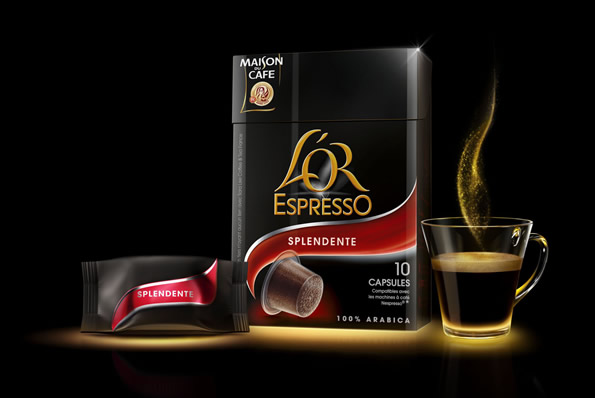
Nespresso owns 1,700 patents relating to its coffee capsule system, and most are set to expire in 2012. Until then, Nespresso is aggresively asserting its intellectual property rights against Sara Lee and the Ethical Coffee Company, a business started by ex-Nespresso executive Jean-Paul Gaillard. In a court battle which could begin next month in Paris, both competitors will claim that their capsules, though they are compatible only with Nespresso machines, are sufficiently unique so as not to infringe on Nespresso's intellectual property.
If Nespresso loses, its image as proprietor of an exclusive, closed coffee club stands to be tarnished with the entry of low-cost alternative capsules.
![]() |
| Sara Lee L'or Capsules |
| Ethical Coffee Company's Casino Capsules |
Wednesday, August 25, 2010
BLU+Vodka in a Can - Is This Even Legal?
Labels:
Energy Drinks
On my way to work this morning, I noticed a billboard advertising a new energy drink. Energy drinks taste weird to me, and sometimes I feel chest pains drinking them. But this one had VODKA featured on its lable. BLU (competitor to Red Bull) is now selling cans of energy drinks with vodka already included. Very clever indeed.
.jpg)
Vodka and Red Bull is a really popular drink in Israel, and the obvious advantage of this product is that you no longer need to buy a whole bottle of vodka to spike a can of Red bull. The alcohol level is 4.9%, and Vodka on its own is supposed to have 37.5% alcohol. That means that given the total volume of 335 mL, there is a total of 16.416 mL of alcohol, or 43 mL of vodka - or 1 part energy drink to 7 parts vodka. Is that a good ratio? I have no idea.
The Israeli energy drink market has gotten really crowded. Red bull was the first here in 1999, establishing its own Israeli distributor in 2007, and then nosediving to the bottom of the market. In 2004, Polish XL entered the market and bit a giant chunk out of Red bull's market share. With an explosive advertising budget, startegic partnerships with nightclubs, and an established distribution chain to convenience stores across the country, XL positioned itself as Israel's number one energy drink, holding 70% of the market share in 2007. SFS (Shamshoun Fouzi & Sons, Elit's chocolate distributor to the Palestinian territories founded in the 70s) was so successful with XL that Israel now comprises 75% of XL's entire global sales. With a bitter legal battle, XL revoked the distribution license of SFS in September 2008 and gave it to Sides, which lost the license one year later to Tempo. SFS went on to produce its own successful energy drink, which it called BLU, and which now commands 25% of the market. XL has fallen to 56% market share, and Red bull has entirely lost its lead with a dismal market share of 8%.
Still more companies have tried to capitalize off the drink's popularity. Jaffora, distributor of such brands as RC and Spring, as well as two competing bottled water companies, brought Red Rain from Canada in May 2009. Tempo itself, before investing in XL, tried to produce its own energy drink called Xi, which was a complete flop.
Combining Vodka with an energy drink is risky. One known consequence is that drinkers experience inebriation without being aware that they are drunk. A University of Florida study found that consumers of this combo were more likely to drive home drunk because of this effect. Red Bull itself makes your blood stickier, with the consumption of a single can giving a person a heart profile similar to a heart disease sufferer. Add alcohol, and your body is being put through a lot. I hope BLU Energy Vodka is certified as safe by the Ministry of Health.
In any event this new product is a clever, if irresponsible, move by SFS to rise above the increasing competition in the Israeli energy drink market. I'll bet that the rest will quickly follow suit, producing Vodka+Energy Drinks of their own.
.jpg)
Vodka and Red Bull is a really popular drink in Israel, and the obvious advantage of this product is that you no longer need to buy a whole bottle of vodka to spike a can of Red bull. The alcohol level is 4.9%, and Vodka on its own is supposed to have 37.5% alcohol. That means that given the total volume of 335 mL, there is a total of 16.416 mL of alcohol, or 43 mL of vodka - or 1 part energy drink to 7 parts vodka. Is that a good ratio? I have no idea.
The Israeli energy drink market has gotten really crowded. Red bull was the first here in 1999, establishing its own Israeli distributor in 2007, and then nosediving to the bottom of the market. In 2004, Polish XL entered the market and bit a giant chunk out of Red bull's market share. With an explosive advertising budget, startegic partnerships with nightclubs, and an established distribution chain to convenience stores across the country, XL positioned itself as Israel's number one energy drink, holding 70% of the market share in 2007. SFS (Shamshoun Fouzi & Sons, Elit's chocolate distributor to the Palestinian territories founded in the 70s) was so successful with XL that Israel now comprises 75% of XL's entire global sales. With a bitter legal battle, XL revoked the distribution license of SFS in September 2008 and gave it to Sides, which lost the license one year later to Tempo. SFS went on to produce its own successful energy drink, which it called BLU, and which now commands 25% of the market. XL has fallen to 56% market share, and Red bull has entirely lost its lead with a dismal market share of 8%.
Still more companies have tried to capitalize off the drink's popularity. Jaffora, distributor of such brands as RC and Spring, as well as two competing bottled water companies, brought Red Rain from Canada in May 2009. Tempo itself, before investing in XL, tried to produce its own energy drink called Xi, which was a complete flop.
Combining Vodka with an energy drink is risky. One known consequence is that drinkers experience inebriation without being aware that they are drunk. A University of Florida study found that consumers of this combo were more likely to drive home drunk because of this effect. Red Bull itself makes your blood stickier, with the consumption of a single can giving a person a heart profile similar to a heart disease sufferer. Add alcohol, and your body is being put through a lot. I hope BLU Energy Vodka is certified as safe by the Ministry of Health.
In any event this new product is a clever, if irresponsible, move by SFS to rise above the increasing competition in the Israeli energy drink market. I'll bet that the rest will quickly follow suit, producing Vodka+Energy Drinks of their own.
Tuesday, August 24, 2010
Expert Nespresso vs. illyEspresso Comparison
Nespresso and iperEspresso capsules underwent rigorous testing at Kenneth Davids's 'Coffee Review'. Conclusion: They both produce really good espresso, but Nespresso's cheaper and offers more variety. I think I'll stick with Nespresso for my capsule needs.
Also I have a feeling Illy's cheating with their crema production - LAME.
Subscribe to:
Posts (Atom)